

Derma Roller: Everything You Need to Know Before Trying Microneedling at Home
Tiny needles rolling across your face sounds like the opposite of good skincare advice. But derma rolling, also known as microneedling, has quietly become one of the most effective at-home treatments for texture, fine lines, and overall skin renewal, and once you understand the actual science behind it, the needles make a lot more sense than they sound.
If you've been curious about trying microneedling at home but the concept still feels a little intimidating, here's exactly what's happening, what it can genuinely do for your skin, and how to do it safely.
What a Derma Roller Actually Is
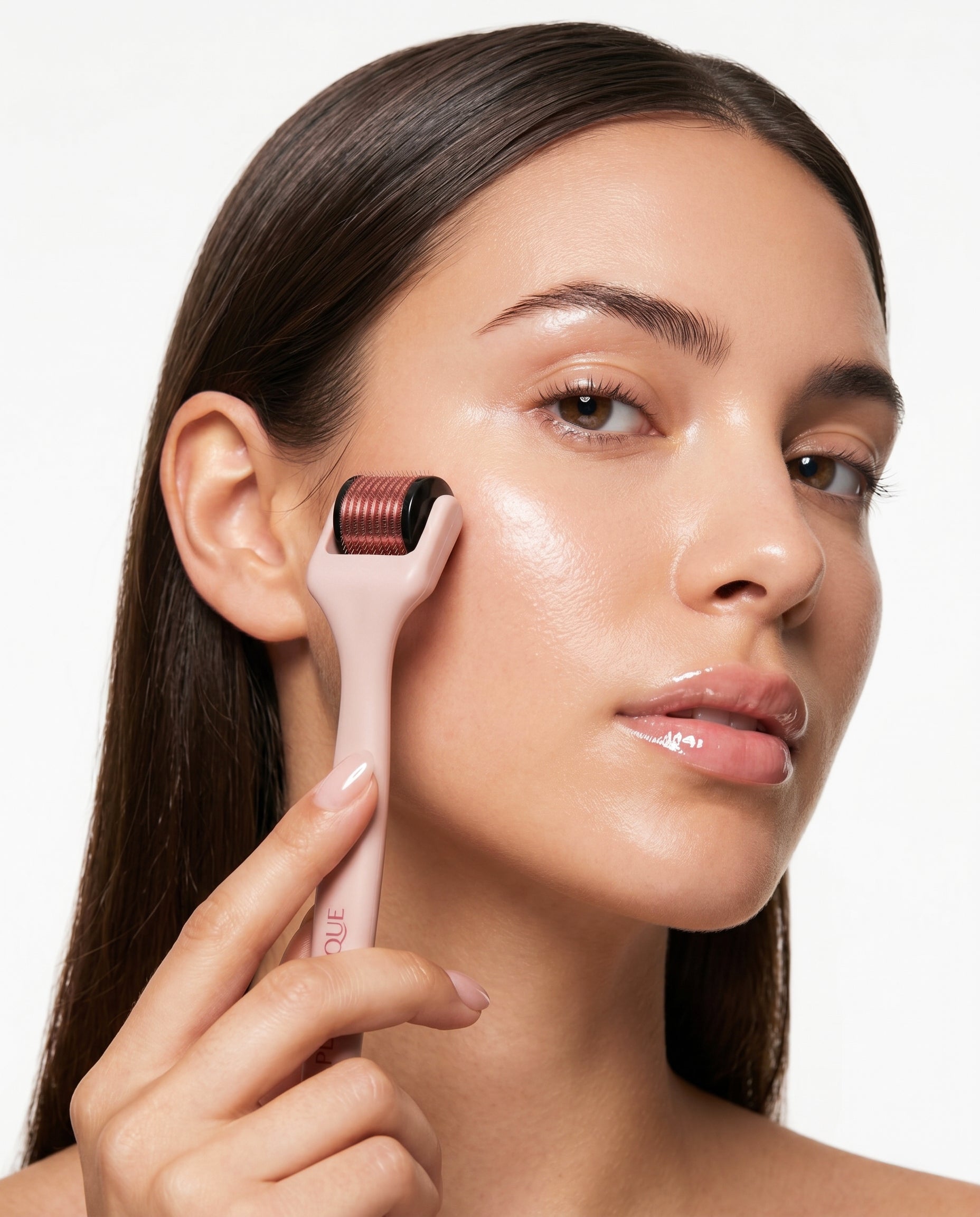
A derma roller is a small, handheld device covered in fine, short needles that roll across your skin, creating microscopic, controlled punctures. That's genuinely the entire mechanism. It sounds more dramatic than it feels in practice, these are extremely fine needles, typically far shorter than what's used in professional in-office treatments.
The technique, microneedling, was originally developed by dermatologists and plastic surgeons for professional use, long before at-home versions became widely available. The at-home version uses much shorter needles specifically calibrated for safety without professional supervision.
The Science Behind Why This Actually Works
Here's the part that makes derma rolling genuinely effective rather than just a scary-sounding trend: those tiny punctures trigger your skin's natural wound-healing response.
When your skin senses these microscopic injuries, it responds by ramping up collagen and elastin production, the proteins responsible for firmness, elasticity, and smooth texture. This is the same underlying mechanism behind many professional treatments, just delivered at a much gentler, safer intensity for home use.
The controlled micro-injuries also create temporary micro-channels in your skin, which significantly enhances how well your other skincare products absorb immediately afterward. This is why so many people apply a serum right after derma rolling, the ingredients penetrate more deeply than they would on unpunctured skin.

What Derma Rolling Can Actually Help With
Improved texture. As your skin's natural repair and collagen production process kicks in, overall texture becomes smoother and more even over consistent use.
Reduced appearance of fine lines. The collagen-boosting effect can contribute to softer, less pronounced fine lines over time, particularly with regular, patient use over several months.
Minimized acne scarring. Many people specifically use derma rolling to address the appearance of acne scars, as the renewed collagen production can help fill in and smooth out scarred texture over an extended period.
Reduced appearance of enlarged pores. As skin texture and firmness improve, pores can appear visibly smaller and more refined.
Better product absorption. Immediately following a session, your skin can absorb serums and treatments considerably more effectively than usual, making it an excellent complement to your existing active ingredients.
Support for scalp and hair health. Some people use derma rolling on the scalp specifically to support hair growth, since the same circulation-boosting, healing-response mechanism applies there as well, though evidence in this specific area is still considered limited.
How to Actually Use a Derma Roller Safely
Step 1: Start with a clean face and clean tool. Wash your face thoroughly, and sanitize your derma roller with rubbing alcohol before every single use. This step is non-negotiable, since you're creating micro-openings in your skin that need to stay free from bacteria.
Step 2: Roll gently, don't press hard. Using light, even pressure, roll the device across your skin in different directions, horizontally, vertically, and diagonally, over each section. You should feel light pressure, not pain.
Step 3: Don't go over the same area repeatedly. A few passes per section is enough. Excessive rolling over the same spot increases the risk of irritation or, in more extreme cases, actual skin damage.
Step 4: Apply a hydrating serum immediately afterward. This is when your skin is most receptive to absorption, making it an ideal time to apply hyaluronic acid or another gentle, hydrating active ingredient.
Step 5: Skip harsh actives and sun exposure for a few days. Avoid strong exfoliating acids, retinol, and direct sun exposure immediately after a session, since your skin needs time to properly recover.
Frequency: Most guidance suggests once or twice a week for at-home use. More frequent use doesn't accelerate results and meaningfully increases the risk of irritation or damage.

Choosing the Right Needle Length
This matters more than people realize. At-home derma rollers typically use needle lengths around 0.25mm, considerably shorter than the 0.5mm to 2.5mm range used in professional, in-office treatments.
Shorter needles are the appropriate, safer choice for home use without professional supervision. Longer needles increase both the potential benefit and the risk, which is exactly why they're reserved for dermatologist or licensed professional settings. Stick with shorter needles for your at-home routine, and don't assume a longer needle will deliver faster or better results, it primarily increases risk without proportional reward.

What's Normal vs. What's a Warning Sign
Normal after a session: Mild redness, similar to a light flush, and slight sensitivity for a few hours afterward. This typically resolves within the same day.
Not normal, stop and reassess: Severe irritation, noticeable swelling, prolonged redness lasting more than a day, or any signs of infection like unusual discharge or increasing pain. If you experience any of these, discontinue use and consult a dermatologist.
Who Should Avoid At-Home Microneedling
Derma rolling isn't right for everyone, and it's worth being honest about who should skip it or check with a professional first.
Avoid or consult a dermatologist first if you have: Active acne breakouts, eczema, psoriasis, or other active skin conditions. Rolling over inflamed or broken skin increases infection risk and can worsen irritation.
Use extra caution if: You have very sensitive skin prone to reactivity, or you're new to active skincare ingredients in general. Starting with less frequent use and monitoring your skin's response closely is the safer approach.
Setting Realistic Expectations
This is important: microneedling at home is genuinely effective, but it's a patient, gradual process, not an overnight transformation.
Most people start noticing initial improvements in texture and radiance after 4 to 6 weeks of consistent use. The more significant collagen-related benefits, smoother texture, reduced fine lines, improved scarring, typically continue developing over several months of regular, careful use. This aligns with how collagen synthesis actually works in your body, it's a gradual biological process that can't be rushed.
Combining consistent microneedling with a solid, gentle skincare routine and diligent sun protection gives you the best foundation for seeing genuine, lasting results.
Hygiene: The Part You Genuinely Can't Skip
Because derma rolling creates actual micro-openings in your skin, hygiene isn't optional, it's the single most important safety factor in this entire routine.
Sanitize your roller before and after every use with isopropyl alcohol. Never share your derma roller with anyone else, even a partner or family member, since this significantly increases infection risk. Replace your roller every few months, since the needles can dull or bend with repeated use, reducing effectiveness and potentially increasing irritation.
The Bottom Line
A derma roller looks intimidating, but the underlying science, controlled micro-injury triggering your skin's natural collagen production, is genuinely effective when done correctly and safely. With the right needle length, proper hygiene, gentle technique, and realistic patience for results that build over months rather than days, at-home microneedling can be a meaningful addition to your skincare routine.
Ready to try it? The Derma Roller for Hair & Skin is designed with a safe 0.25mm needle length suited for at-home use, whether you're focused on facial texture or scalp health.
Read more
If you've been searching for ways to define your jawline and reduce the appearance of a double chin, you've probably come across a confusing mix of terms: face sling, face strap, chin strap, jaw st...
Athletes have used ice for recovery for decades. Dermatologists use cold treatments to calm inflamed skin after procedures. And somewhere in between those two worlds, the humble ice roller emerged ...